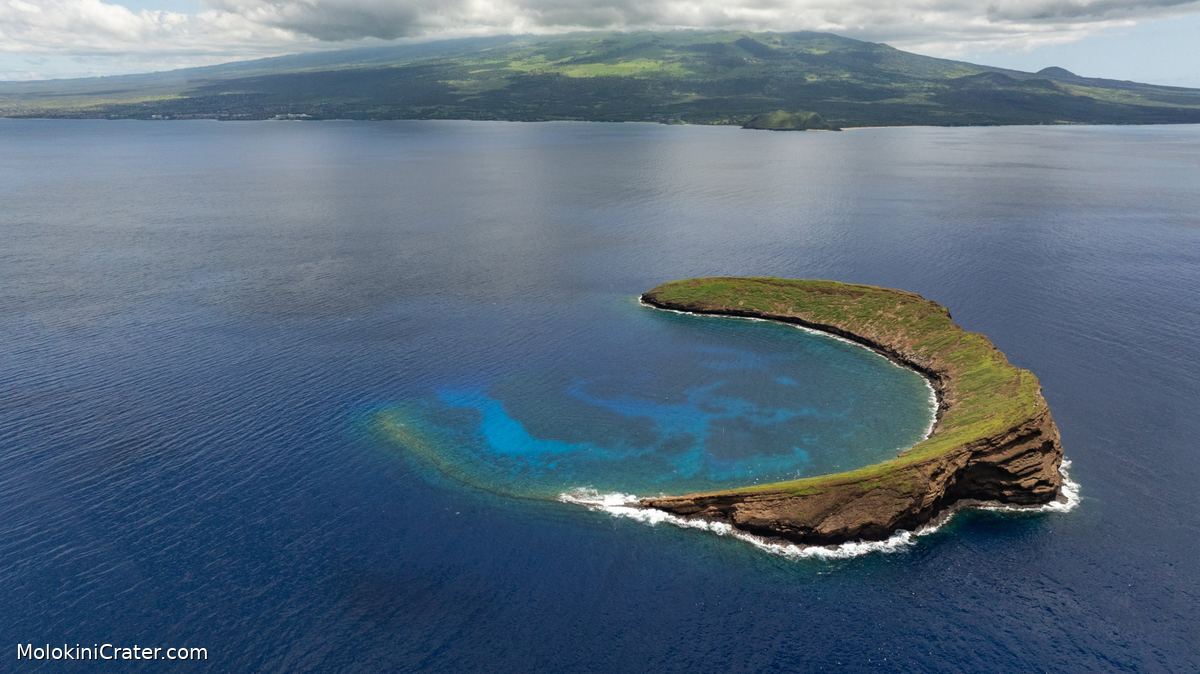
The newest science on Molokini Crater says two things at once: the protected crater still holds more sharks, jacks and live coral than the open reefs along South Maui, and the daily boat traffic you’re part of measurably changes how its fish behave. Here’s what researchers have actually found, with the numbers, and what it means if you’re booking a Molokini snorkel trip.
How Old Is Molokini Crater?
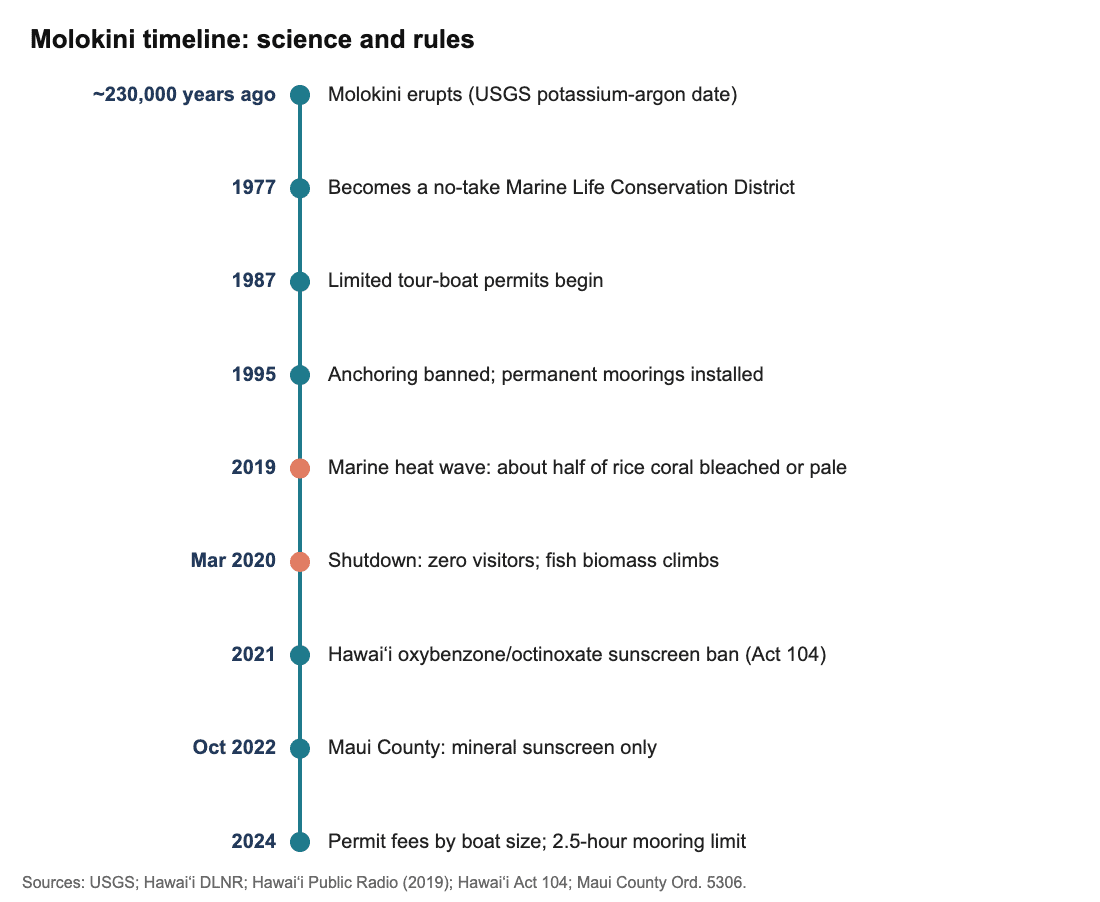
The U.S. Geological Survey dates Molokini’s eruption to about 230,000 years ago, give or take 90,000 years. It’s a tuff cone that rises about 500 feet (150 m) from the seafloor, and the crescent you see from Kīhei and Wailea is the rim of a crater roughly 1,770 feet (540 m) across.
The inner cove slopes down to about 100 feet (30 m). Outside, the back wall drops past 200 feet (60 m). Most snorkel boats tie up inside the crescent; the back wall is a drift dive or an advanced snorkel for calm days only.
The islet itself is a state seabird sanctuary. Nobody lands on it.
Does Protection Actually Work at Molokini?
Yes, and the data is fairly clear. Molokini became a no-take Marine Life Conservation District in 1977, so no fishing, no collecting, no feeding. In a NOAA survey of Hawaiʻi’s protected areas from the mid-2000s, Molokini had the highest fish biomass and the highest predator biomass of every MLCD in the state.
Compared with nearby open-access reefs in South Maui, the gap looked like this:
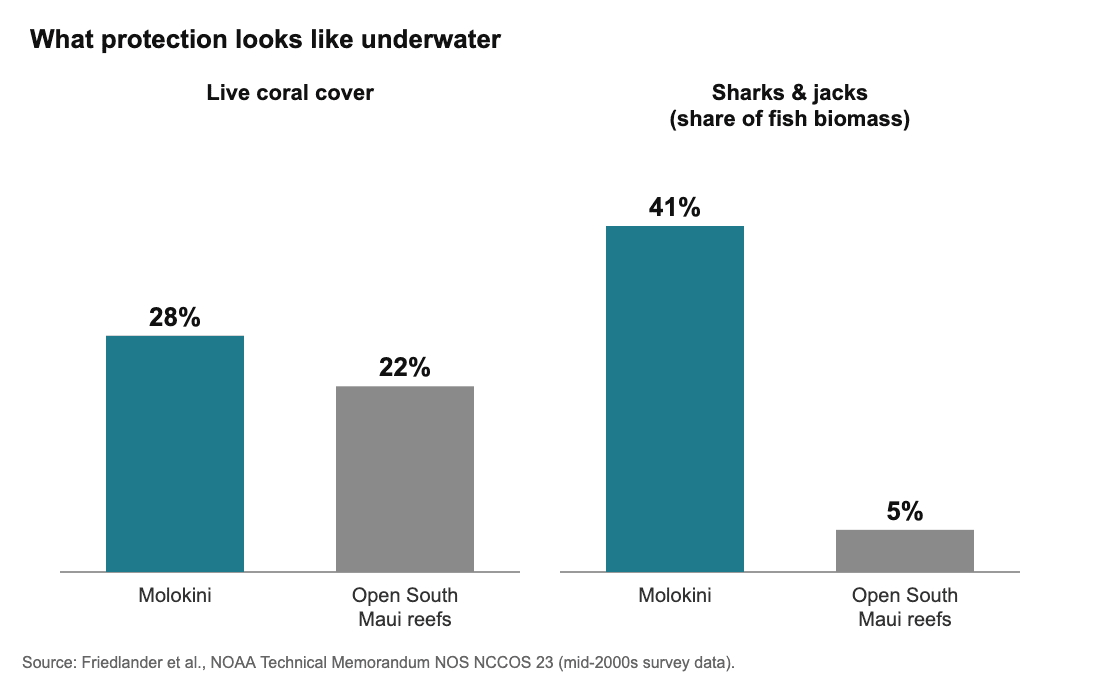
Sharks and jacks made up 41% of fish biomass at Molokini versus 5% on the open reefs. Predators are the first thing fishing removes, so that gap is the clearest sign the protection is working.
One caveat: those survey numbers are from the mid-2000s. More recent state surveys report that fish biomass inside the crater fell about 44% over two decades of monitoring. The protection still shows, but the crater isn’t untouched.
What the 2020 Shutdown Taught Scientists
This is the most useful Molokini study in years, and it came out of an accident.
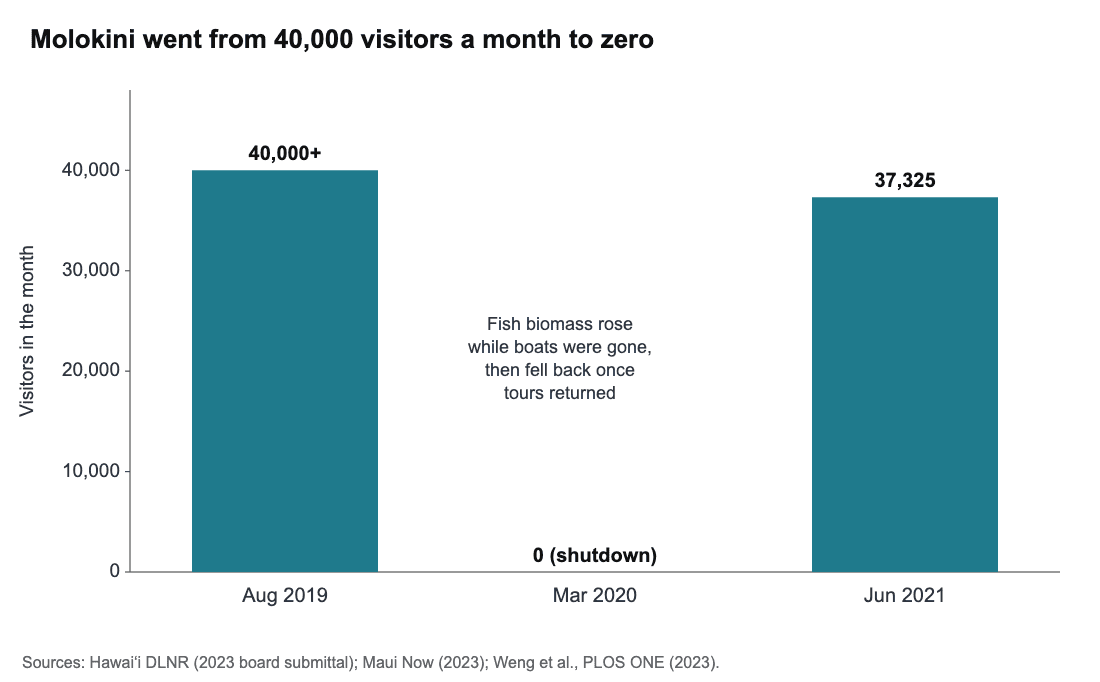
In a typical month before the pandemic, more than 40,000 people visited Molokini. In March 2020, that number dropped to zero. Researchers had already been tagging and counting fish there, so they had a before, a during and an after.
The results, published in PLOS ONE in 2023:
- Fish biomass went up while the boats were gone, driven mostly by ʻōmilu (bluefin trevally) moving into the shallow crater.
- Once tours resumed, biomass and predator use of the shallows dropped back to pre-pandemic levels. One researcher told The Maui News that total biomass fell about 25% between April 2020 and 2021 as boats returned.
- An earlier tagging study found that half of the tracked ʻōmilu left the shallow crater when more than 12 boats were moored there.
So the fish didn’t vanish when tourism came back. They moved. If you’ve snorkeled Molokini on a packed morning and wondered where the big jacks were, that’s a decent answer.
How Many People Visit Molokini?
State figures put Molokini at roughly 300,000 visitors in 2010, 334,036 in 2015 and more than 360,000 in 2018. A state report from 2013 to 2015 averaged 23 boats and 924 people a day.
There are 40 active commercial permits and 26 state day-use moorings. A 2009 visitor survey found people thought about 15 boats at once was acceptable. On busy summer mornings, it can feel like more.
Coral Bleaching at Molokini
Warm water is the bigger long-term threat (here are five things most people don’t know about coral bleaching). During the 2019 marine heat wave, about half of the rice coral (Montipora capitata) at Molokini was bleached or very pale, according to monitoring reported by Hawaiʻi Public Radio. Earlier state monitoring also flagged a coral disease rate at Molokini of about 1.9% of colonies in 2013, roughly four times the Hawaiʻi background rate of under 0.5%.
Protection keeps fishing and anchors off the reef. It doesn’t keep the water from heating up.
New Molokini Rules You’ll Notice
The state’s current Molokini mooring rules, compiled in March 2024, include:
- Commercial permits that cost $1,500 to $6,000 every two years depending on passenger capacity, up from $50.
- A 2.5-hour limit on day-use moorings.
- No private boats on empty commercial moorings during the morning rush (7:30 to 9:30 a.m.).
- No anchoring in the mooring area.
What This Means for Your Trip
Go early, but know you won’t be alone. Morning is calmer and clearer, which is why every boat goes then. If a tour advertises being first to the crater, that’s worth paying attention to.
Pick the boat size for your comfort, not the fish. The research tracked how many boats were moored, not how many people were on them, so a small charter won’t empty the crater for you. It does mean fewer fins around you in the water than on a 120-person catamaran.
Mineral sunscreen only. Hawaiʻi banned oxybenzone and octinoxate sunscreens in 2021, and Maui County went further in October 2022: only mineral sunscreens (zinc oxide or titanium dioxide) can be sold here. A rash guard is easier and lasts longer.
Don’t stand, don’t touch, don’t feed. It’s a no-take district, and the crater floor is living coral and sand channels, not rock.
Consider the back wall only with a good crew. The 200-foot (60 m) drop is exciting, but currents there can be strong. Trust the captain’s call, and read up on other Molokini dive spots before you go.
Molokini Crater FAQ
Is Molokini’s coral dying?
Not wholesale. It took a real hit in the 2019 heat wave, and fish biomass has declined over two decades, but survey data still shows more coral and far more predators than open South Maui reefs.
Did the pandemic help Molokini?
Temporarily. Fish biomass rose during the 2020 shutdown and returned to earlier levels once boats came back.
How deep is Molokini?
About 100 feet (30 m) inside the crater and more than 200 feet (60 m) along the back wall.
Can you fish at Molokini?
No. It’s been a no-take Marine Life Conservation District since 1977.
Sources
- Weng et al., Decreased tourism during the COVID-19 pandemic positively affects reef fish in a high use marine protected area, PLOS ONE (2023)
- USGS, Molokini erupted about 230,000 years ago
- Hawaiʻi DLNR Division of Aquatic Resources, Molokini Shoal MLCD
- Friedlander et al., NOAA Technical Memorandum NOS NCCOS 23
- Hawaiʻi DLNR, Molokini rules news release (2023)
- Hawaiʻi Public Radio, 2019 coral bleaching coverage